|
The
Forms of Isshinryu
(And
some reflections on Steve Armstrong, who passed away
November 15, 2006)
 Walk with me a bit, down the corridors
of time, to an era when American Karate was in its
infancy. Back then, I lived in Philadelphia. It was the
60's, and martial arts was something occasionally
portrayed in comic book ads (Are you old enough to
remember Count Dante?), but not found in the everyday
world. This was before Bruce Lee, and Chuck Norris, and
even before Five Fingers of Death appeared on
the horizon as the first major release of a true martial
arts film. It wasn't available, didn't exist, and if you
were lucky enough to find a dojo, you'd have to eat dirt
to get in. Walk with me a bit, down the corridors
of time, to an era when American Karate was in its
infancy. Back then, I lived in Philadelphia. It was the
60's, and martial arts was something occasionally
portrayed in comic book ads (Are you old enough to
remember Count Dante?), but not found in the everyday
world. This was before Bruce Lee, and Chuck Norris, and
even before Five Fingers of Death appeared on
the horizon as the first major release of a true martial
arts film. It wasn't available, didn't exist, and if you
were lucky enough to find a dojo, you'd have to eat dirt
to get in.
I knew of only one school
in all of Philadelphia back then. It was a traditional
Japanese school (I now believe it was a Shotokan
academy), and the workout floor was hardwood, finely
polished, class impeccably clad in white Gi's, and a
Sensei right out of my imagination. Of course, it was in
a part of town prohibitive for me to enter, and frankly,
the severity of the program was, by my measure, beyond
what I could endure.
|
|
|
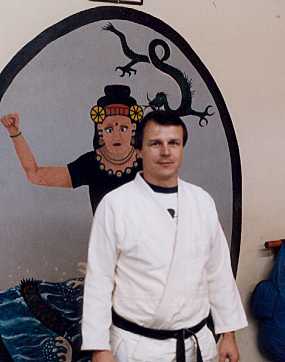
The
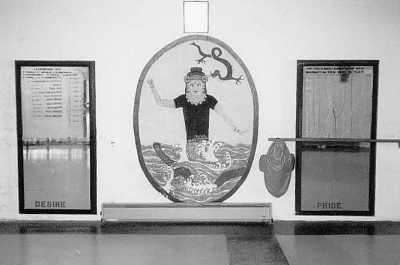
Armstrong Dojo, facing the Mizugami
|
|
In many ways, those days
seem like a distant dream. There were no videos, and
television was still in its infancy...strictly Jackie
Gleason, Milton Bearle, Ed Sullivan, etc. However, my
interest stuck, and I searched everywhere for anything I
could find on the arts. I remember my first big "hit"
was a bookstore off of Roosevelt Blvd. and Cottman,
where one afternoon, I struck gold. On the sports
bookshelf was a book by Gichin Funakoshi (Karate Do
Kyohan), which, when I inspected it, looked to be the
outline of a complete system. It took several weeks for
me to earn the $17.00 (back then, a considerable sum for
a book), but eventually I bought it, and with the
Master's guiding hand, launched my study of Karate. The
same bookshelf later contained works on a style called
Isshinryu, written by a Steve Armstrong. Reading and
thumbing through them, I saw they were a detailed
explanation of Isshinryu Kata, or forms, written by this
Armstrong, who had apparently studied the art while
stationed on Okinawa. I never imagined an American would
be so knowledgeable as to be able to produce his own
textbook, and the name “Armstrong” stuck. Someday, fate
permitting, I would seize the opportunity to meet this
Armstrong, and hear in his own words, how he had come to
learn Karate and propagate it in America.
|
|
|
The
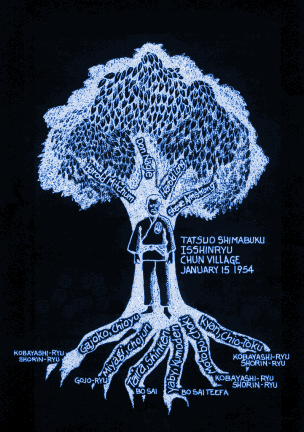
Family Tree of American Isshinryu
|
|
Aside from that, there was
nothing. I learned what I could from Master Funakoshi's
book, and ultimately was blessed to find a true Shotokan
instructor in St. Louis, who filled in what was missing
from my training regimen. I had been in Shotokan for
several years, when a new art began to make inroads, Tae
Kwon Do. Who would have thought that within several
years, Tae Kwon Do would become a universal entity, and
Shotokan, with its rigorous training and demands for
perfect execution, would gradually fade to the
background. It was the late 60's and there were whispers
of a West Coast phenomenon named Bruce Lee. I attended
St. Louis University and experienced my first Karate
tournament (In those days, there might be one, possibly
two, during the course of a year). Sensei Steve
Armstrong was now bigger than ever, with his Seattle
Open getting national recognition. Tacoma, Washington,
where he housed his school, was to some of us in the
outlands a Mecca of inspiration. Of course, I don't mean
to slight the other "greats" by failing to mention them
here. The point is American Karate was in its infancy,
and my path is singular. There was Ed Parker, Joe Lewis,
Chuck Norris's star was on the ascendant, Mr. Cho in New
York, Sensei Don Nagle in New Jersey, Harold Mitchum,
Sensei Long, Fred Hamilton, Slocum and Pierce of New
York, Keehan of Chicago (before he became Count Dante),
and many more. These gentleman were pioneers, and to a
person, were deadly serious about what they taught.
Their skills were generally hard earned, learned well,
and taught well. Martial Arts became their lives, and in
many instances, their sole source of income and
inspiration. Still, even in the late 60's, schools and
instructors were scarce, and one had to exert
considerable effort to find a receptive school.
Tournaments were sometimes months and thousands of miles
apart, and required genuine sacrifice to attend.
Doubtless you're too young to recall, but it was before
the deregulation of Airlines, and a typical cross
country flight would cost the equivalent of a month's
wages. Some of the warriors back then were true ronin,
carrying blankets on their shoulders (there were no back
packs like today's, and no such thing as a day pack) and
spending nights under bridges or on the roadside. At
about that time, the Long Beach Internationals (Ed
Parker's tournament) blossomed into the acknowledged
national championship event, and held that prestigious
position for nearly fifteen years. To give you an idea
about how small the entire scene was, Mr. Parker and
Steve Armstrong were mutually supportive friends, as
they were with many others, including Chuck Norris.
Bruce Lee was originally from Seattle (Armstrong's
sphere of influence), and it was Parker's Long Beach
Internationals where a young Bruce Lee gave a brief
demonstration which turned the entire American Martial
Arts scene on its ear. Living in St. Louis, I continued
my endeavors in Shotokan, but attempted to get other
exposure where I could...there was only Tae Kwon Do, and
believe it or not, back then, Tae Kwon Do forms still
echoed the forms outlined in Funakoshi's Karate Do
Kyohan (They have since been completely reworked, so as
to more effectively incorporate the traditional Korean
Art of Taekyon into their presentation). It wasn't until
the late 60's that the door opened for learning the
Chinese arts. Earlier, I had lived with several Chinese
who were clearly quite skilled in traditional arts,
which they practiced diligently in their rooms, or in
private locations, beyond my scrutiny. When questioned,
they denied knowing anything, and never volunteered to
discuss. Thank goodness we're beyond that!
|
|
|
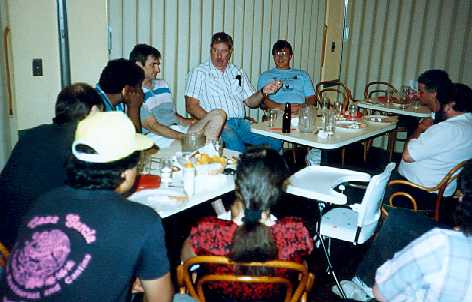
Recalling
the “old Days” with Sensei Armstrong
(circa 1993)
|
|
Well my story regarding
Mister Armstrong comes full circle. After St. Louis
University, I traveled back to New Jersey, then to
Philadelphia, and ultimately ended up in the Army,
relocated to Monterey, then to Southeast Asia. I
continued my personal pursuit of excellence in the arts,
and had opportunity to broaden my experience by
immersing into Hap Ki Do, Wing Chun, Arnis, Thai Boxing,
and Chinese sword. During my travels I worked personally
with several masters, and even learned Chinese Mandarin.
It wasn't until the mid seventies that I finally got to
Tacoma, WA. Actually, I returned to the states and was
stationed at Ft. Lewis, just outside Tacoma. It was
through a friend, Earl Squalls, that I had my first
opportunity to meet Sensei Armstrong.
On first contact, I was
blown away by his physical size. At the time, I
stood 6'3" tall, and usually weighed in at 225
lbs, yet I felt dwarfed by Mister Armstrong. This is
hard to explain, he wasn't much taller than I was, nor
did he weigh much more. It's just that everything about
him was big. His hands were huge, and all I could think
on first seeing those "paws" was he could kill me if he
ever hit me. They were nothing less than battering rams.
Master Armstrong was 44 years old and still in his
physical prime. He was pretty much held in awe by all
who knew him. Not just because of his imposing presence,
but because of his absolute command of Isshinryu, and
Karate in general. With a glance, he could discourse for
an hour on all the things he found in your Kata that
could be improved. His power was awesome, and one of his
typical "feats" was to throw a pine board in the air,
and "nail" it with a punch, while it was free floating.
The board would explode. If you think that's easy, try
it sometime. Few people talk about Mr. Armstrong's past,
but he was a bona fide war hero, having established
himself in the Korean War, and gaining enough notoriety
from his exploits that he became a member of President
Truman's personal guard before reaching the age of
twenty (yes, he enlisted underage). From the first
encounter to the very end, Armstrong emphasized that
meeting Tatsuo Shimabuku was the turning point of his
life. Master Shimabuku is known to us mostly through the
reflection of his art through generations of Isshinryu
students. Armstrong knew the man, and maintained
adamantly he never met a master who compared to
Shimabuku.
Imagine the diminutive
Shimabuku meeting Armstrong the first time, then
laughing when Armstrong said he was a Black Belt.
Shimabuku expected performance, and that remains the
tenet of Isshinryu to this day. Armstrong wanted to work
with Shimabuku, and indicated he already held Black Belt
status (nidan). Shimabuku asked Armstrong to
demonstrate, then laughed him off the floor. He did,
however, invite him to become a student. That began a
relationship that continued over the years until
ultimately, Master Shimabuku promoted Armstrong to 10th
dan (Donald Wasielewski attested to the existence of the
certificate, and also Mr. Armstrong's personal copy of
the Scroll of Kumite).
I eventually developed a
friendship with Armstrong. I was working Arnis with
Sensei Dave Bird, and had been accepted as a student by
Master Archibeque. That took most of my time.
Armstrong and I remained in contact for those several
years, having no clue about the evolving brain tumor
that was to derail his life in the martial arts on
September 8, 1977. That story is detailed in his
Isshinryu Karate.
His recovery from the
tumor removal was a nightmare, and it would not be
unkind to say he was never the same person again.
Certainly his awe inspiring persona remained, but his
physical prowess diminished, as did his ability to
remain physically active. Tragically, his judgment
clouded, and he alienated some of his most highly
regarded Black Belts, many of whom are established
Sensei even today. Without the fountainhead of Mr.
Armstrong's robust self, his influence in the world of
martial arts diminished (Did you know he was a member of
Elvis's Black Belt promotion panel?), and new voices
were on the horizon, eager to force retirement on
whoever remained of America's martial arts pioneers. We
had entered the era of protective equipment in
tournaments (Armstrong wouldn't allow it, always arguing
the best protective equipment was clean technique and
good control), widespread media attention, and the flood
of incoming styles, now in fact too numerous to even
mention. Where once, his was the only show in town, now
there were schools in every neighborhood. The dojo which
had once been filled to overflowing was now populated by
less than a handful of regular participants. Even within
his own style, there were challenges to his stature and
authority.
|
|
|
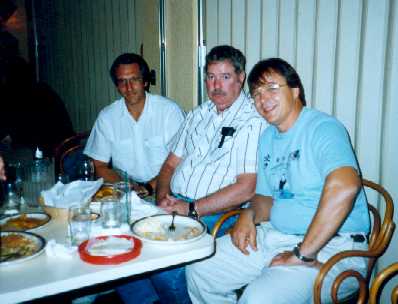
Sensei
Armstrong (Bill Mc Cabe (l), Don
Wasielewski (r))
|
|
Mr. Armstrong had always
been a proud, and headstrong man. Those were his great
attributes, but in the end, they precipitated his
ultimate slide into permanent retirement. Co-incident
with my meeting and befriending Mr. Armstrong, I became
best friends with Don Wasielewski. Per Armstrong, "Don
is the one person, the single person, that I would ever
ask to cover my back, and know it would be covered."
Wasielewski became one of Armstrong's students while
attending University of Puget Sound, where he was a 185
pound lineman on the football team. Armstrong's oft
cited expression that "It's not the size of the the dog
in the fight that's important, it's the size of the
fight in the dog" was inspired by his admiration for
Wasielewski. As fate would have it, I had the
opportunity to learn the Isshinryu system working under
Don, frequently at Master Armstrong's studio. In fact,
toward the end, we had the key to the location, and
reciprocating Master Armstrong's courtesy, allowed for
his senior students to participate in our sessions.
|
|
|
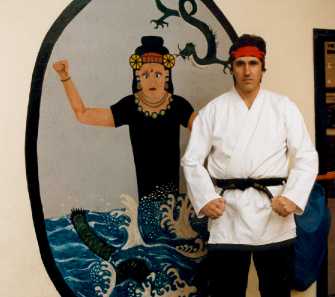
These
photos were taken at the time of
our last visit to Master
Armstrong’s school. We had
learned he decided to
retire. Concerned this would
be our last opportunity to
photograph the School’s Mizugami,
we took these final shots.
Within months, the building was
sold, and the school retired into
history.
|
|
|
|
After several years of
very hard work, Master Armstrong did return to some
level of stature in the martial arts world ("Seven times
you fall down, eight times you get up"). He had
opportunity to travel to Israel, and Europe, where he
authenticated and validated schools in several
countries. Sensei from some of those places came to
spend time with Armstrong, not infrequently staying, as
his guest, on the second floor of his dojo. I had the
good fortune of testing for Isshinryu Black Belt before
Mr. Armstrong on February 20, 1988. He was careful to
scrutinize everything I did, often asking for second
repetitions of my Kata, then offering extended
commentary into the Bunkai (combat applications), and
significance of the many moves. I experienced first hand
the passion he brought to the art, and his desire that
it be passed down, in tact. By decade’s end, Mr.
Armstrong began to backslide from the effects of his
illness. There were incidents between him and some of
his prominent students, who wished to have a degree of
autonomy, ultimately resulting in permanent breaks. His
classes diminished in number, and activity at the school
became marginal. He became forgetful, and heaven help
the soul who fell from his favor. There were some
incidents where lesser Black Belts either challenged
him, or intentionally provoked him. I remember one where
the unsuspecting challenger, positive that only a shell
of the former Armstrong remained, was dropped to
helplessness by a front kick that no one ever saw. The
late Earl Squalls (a tournament champion many times
over) commented afterwards the kick would have been
lightning fast for a person half Armstrong's size and
age, making the feat all the more remarkable. Tragically,
the regression continued. Mr. Armstrong slowly
lost the ability to control his emotional swings which
were becoming more pronounced, and even normal physical
activity was becoming a problem. He declared
his intent to retire, and over a short span of time,
liquidated his assets and resources in Tacoma and closed
his school. Among his final acts was the promotion
and designation of Sensei Donald Wasielewski to be his
successor in authority, and to whom, along with others
such as Master George Shin, he entrusted the
continuing heritage of Isshinryu in the Pacific
Northwest.
Not long after commencing
retirement, Master Armstrong’s continued deterioration
resulted in his care and ultimate residency at the
Washington Veterans Hospital where he passed away on
November 15, 2006.
He was
a pioneer, and made great personal sacrifices to
preserve and perpetuate his Master's art. Where
there was one, there are now many. Thank you
Master Armstrong.
So...dedicating this page to
my friend, and one of the great mentors of my life, I
would like to present the entire package of Kata from
the Isshinryu system. Details are provided
on each of the respective pages.
|